


Table of Contents
ToggleIntroduction (Carding)
Welcome to the ultimate carding tutorial for 2026. This guide is designed for both beginners and experienced carders. It covers everything from the basics of what carding is to advanced techniques for high value transactions.
Carding is the process of using stolen credit or debit card data to make unauthorized purchases. It requires a combination of technical knowledge, operational security, and access to the right tools. This tutorial breaks down every component.
We’ve done the search. Now discover the Real Resources
Finding the right tools shouldn't have to mean endless searching, or taking chances on unknown vendors. That’s why we invested valuable time during our research period to identify useful payment security resources.
Verified and Recommeded Tools / Service Shops
escrow deals for businesses worldwide.
By the end of this guide, you will understand the four levels of carding, what tools you need, how to check if a CC is live or dead, how to execute a carded transaction step by step, and advanced strategies for high value carding.
What is a Carder?
A carder is an individual who engages in the unauthorized use of credit or debit card data to make purchases or withdraw cash. Carding is a specialized form of cybercrime that requires knowledge of payment processing systems, fraud detection mechanisms, and digital anonymity.

Carders acquire card data from various sources including data breaches, phishing campaigns, skimming devices, and dark web markets. They then use this data to make purchases on cardable sites or clone physical cards for ATM withdrawals.
The term carder can refer to anyone involved in the carding ecosystem, from beginners buying their first CVV to experienced operators running automated carding scripts.
Qualities of a Good Carder
Not everyone succeeds in carding. The individuals who do well share specific qualities:
Patience. Carding requires careful setup and testing. Rushing leads to mistakes and detection. Good carders take their time and do things properly.
Attention to detail. Every element of a transaction matters. The IP address, the browser fingerprint, the billing address, the card data, the transaction amount. Good carders check everything before submitting.
Adaptability. What works today may not work tomorrow. Good carders adapt quickly when methods change.
Research skills. Successful carders constantly research new BINs, cardable sites, and bypass techniques. They follow communities and stay updated.

Operational security mindset. Good carders understand that their safety depends on compartmentalization and discipline. They never mix personal and carding activities.
Risk management. Good carders know when to cut losses and walk away from a failing transaction.
The 4 Levels of Carding
Level 1: Basic CVV Carding Using stolen card numbers with valid CVV and expiry dates on websites that do not require 3D Secure authentication. This is the entry level. Most beginners start here.
Level 2: Fullz Carding Using complete cardholder data including billing address, name, phone number, and sometimes SSN. Fullz allows bypassing AVS checks and creating accounts on more secure sites.
Level 3: Dump Carding Using raw magnetic stripe data to clone physical cards. Requires a card writer and encoder. Allows ATM withdrawals and in store purchases.
Level 4: Automated Carding Using scripts and software to automate the carding process at scale. Involves bot detection evasion and mass checkout systems. Only for experienced operators.
Essential Tools for Carding
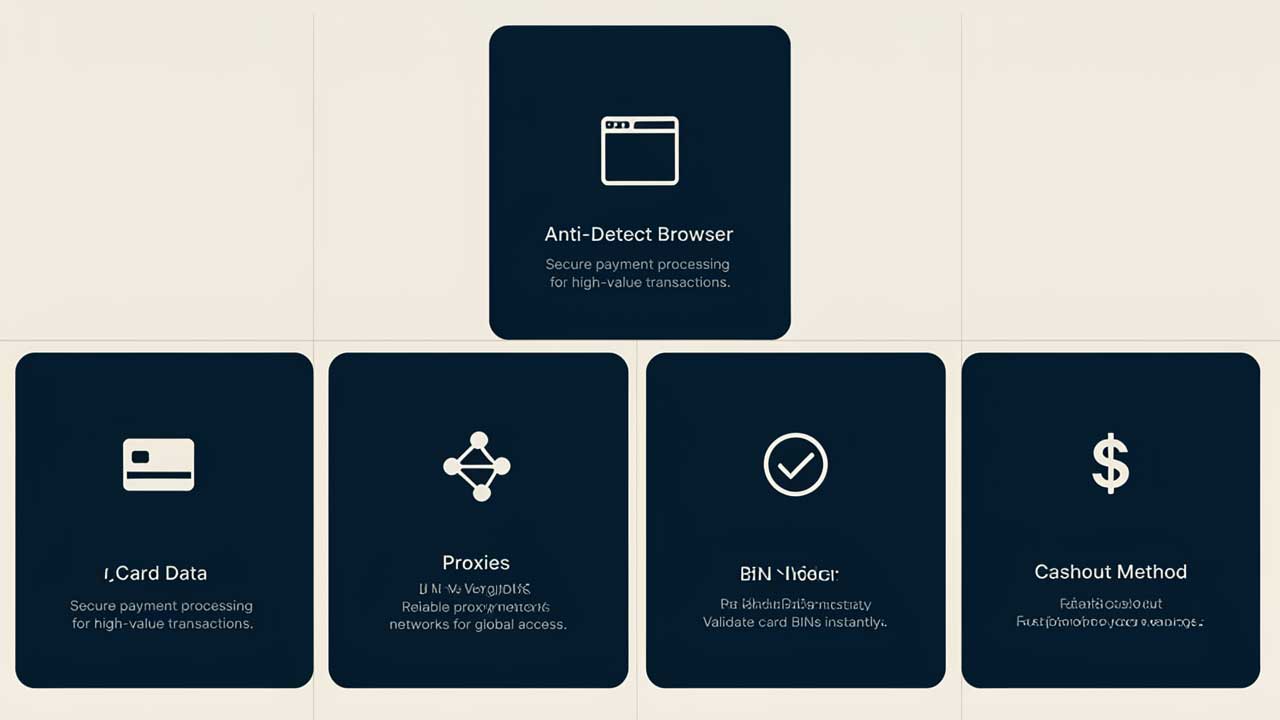
Card Data: Fresh Non-VBV CVVs, fullz, or dumps from trusted vendors. Sources: Vladfox.com, Clonecards.store.
Proxies: Residential SOCKS5 proxies matching the card country. Mobile proxies for high security targets. Sources: Clonecards.store offers SOCKS5 bundles.
Anti-Detect Browser: Multilogin, Indigo, or Dolphin Anty. Pre configured profiles from Worlddumps.com.
BIN Checker: Integrated checker from Vladfox.com. Confirms Non-VBV status before use.
Fresh Accounts: Temporary email addresses for account creation. Aged accounts with purchase history for higher success.
Cashout Method: Money transfer services from Worlddumps.com. Gift card exchange platforms.
Understanding Credit Card Details (CC)
A credit card (CC) consists of several data fields that are required for online transactions:
Card Number: 16 digits for Visa and Mastercard. 15 digits for American Express. The first six digits are the BIN which identifies the issuing bank. The remaining digits identify the specific account.
Expiry Date: Entered in MM/YY format. Must be a future date. Expired cards are declined immediately.
CVV: Card Verification Value. Three digits for Visa and Mastercard. Four digits for American Express. Printed on the back or front of the card. Required for most online transactions.
Cardholder Name: The name as printed on the card. Must match the name on the billing address.
Billing Address: The address associated with the card account. Used for AVS verification.
Types of Credit Cards
Visa: Most widely accepted card network globally. Uses VBV for 3D Secure. Non-VBV Visa cards are common targets.
Key BIN ranges: 400000 to 499999.
Mastercard: Second most widely accepted. Uses MSC for 3D Secure. Non-MSC Mastercard cards are also common.
Key BIN ranges: 510000 to 559999.
American Express: Uses SafeKey for 3D Secure. Higher limits but stronger security. Harder to card.
Key BIN ranges: 340000 to 379999.
Discover: Uses ProtectBuy. Limited acceptance internationally. Common in USA.
Key BIN ranges: 601100 to 601109, 644000 to 659999.
Prepaid Cards: Often no VBV enforcement. Lower limits but easier to card. Good for testing.
Levels of CC Information
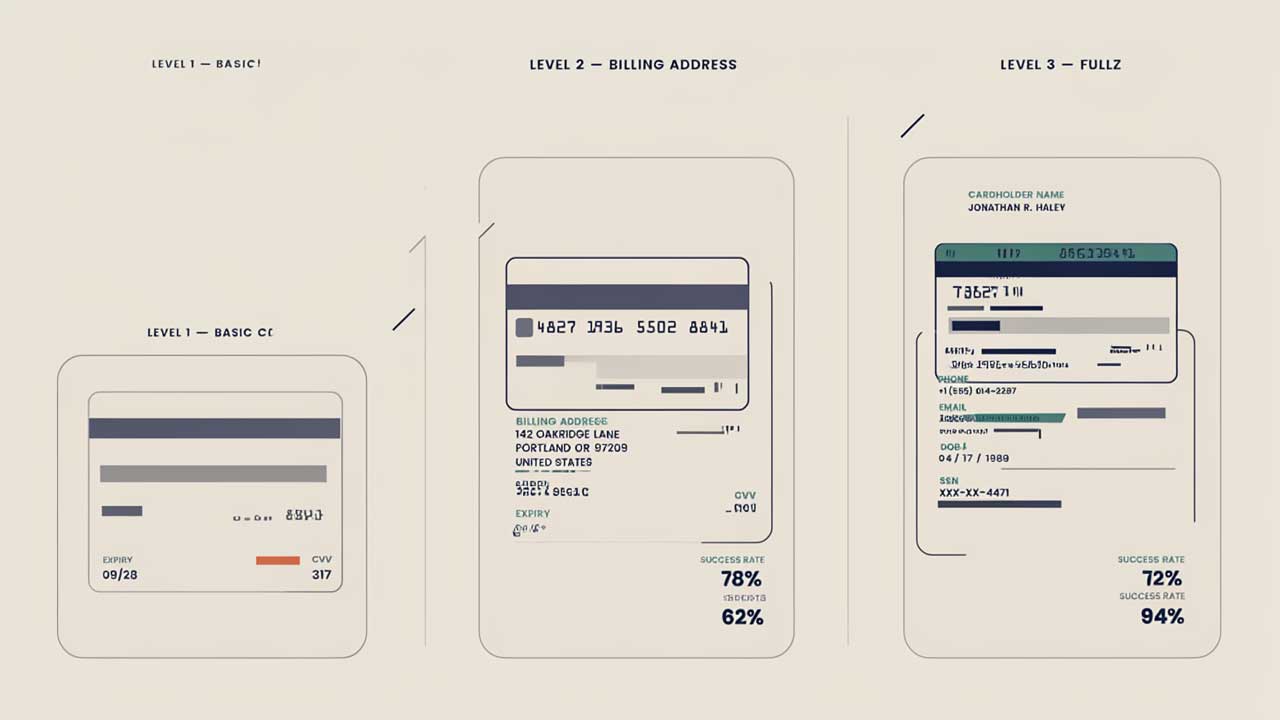
Level 1: Basic CC Card number, expiry date, CVV. Sufficient for sites with weak AVS enforcement. Highest risk of decline.
Level 2: CC with Billing Address Card number, expiry date, CVV, billing address. Allows bypassing AVS checks. Better success rate.
Level 3: Fullz Card number, expiry date, CVV, billing address, cardholder name, phone number, email, DOB, SSN. Allows account creation and enhanced verification bypass. Highest success rate.
How to Check if a CC is Live or Dead
Method 1: BIN Checker Use Vladfox.com integrated checker to confirm BIN status and card validity. This does not burn the card.
Method 2: Small Test Transaction Make a $1 to $5 purchase on a low risk site. If approved, the card is live. If declined, the card may be dead or the BIN may be VBV.
Method 3: Pre-auth Check Some sites allow saving a card without purchase. Adding the card triggers a small pre-authorization that confirms activity.
Signs of a dead card: Immediate decline without any processing. Card not recognized by payment gateway. Expired expiry date. BIN known to be blacklisted.
Key Carding Terms You Must Know
BIN: Bank Identification Number. First six digits of the card.
CVV: Card Verification Value. Three or four digit security code.
Fullz: Complete card data with personal information.
Dumps: Magnetic stripe data for cloning cards.
Non-VBV: Not enrolled in Verified by Visa.
Non-MSC: Not enrolled in Mastercard SecureCode.
OTP: One Time Password. Required for VBV/MSC authentication.
AVS: Address Verification System. Checks billing address.
SOCKS5: Proxy protocol for anonymous browsing.
Drop: Physical address for receiving carded goods.
Cashout: Converting carded goods to cash.
Checker: Tool to test card validity.
Cardable site: Website that can be successfully carded.
Chargeback: Reversal of a fraudulent transaction.
Step-by-Step Carding Tutorial for Beginners
Step 1: Acquire Card Data Purchase fresh Non-VBV CVV or fullz from Vladfox.com or Clonecards.store.
Step 2: Validate the Card Use Vladfox.com integrated checker to confirm Non-VBV status. Test with a $1 to $5 transaction on a low risk site.
Step 3: Set Up Your Environment Install an anti-detect browser. Configure SOCKS5 proxy matching the card country. Clear all browser data.
Step 4: Choose a Cardable Site Start with food delivery or small retail sites. Avoid high security sites initially.
Step 5: Create an Account Use a temporary email address. Use a name close to but not exactly the cardholder name.
Step 6: Make the Purchase Add items to cart. Proceed to checkout. Enter card details. Submit the order.
Step 7: Cash Out For gift cards, use balance transfer method. For digital goods, sell on exchanges. Use Worlddumps.com for bank transfer, PayPal, CashApp, Venmo, Zelle, Western Union.
Why Carding Fails: Common Mistakes
- Using a VBV/MSC enrolled card.
- IP address mismatching card country.
- Browser fingerprint revealing real identity.
- Using the same account repeatedly.
- Testing with large amounts first.
- Poor billing address matching.
- Carding on sites with strong fraud detection.
- Using dead or expired card data.
- Skipping the validation step.
- Poor operational security.
Advanced Tips for Success
- Build your own BIN database with success rates.
- Use aged accounts with purchase history.
- Vary transaction amounts and times.
- Match timezone and language settings.
- Use residential proxies for better detection avoidance.
- Focus on gift cards for immediate liquidation.
- Use balance transfer methods to clean funds.
- Maintain separate identities for different carding activities.
- Test new BINs every week.
- Join communities for real time updates.
Where to Buy Carding Tools and Fresh CC
Vladfox.com: Non-VBV BINs, integrated checker, prepaid cards, carding guides.
Clonecards.store: Clone cards, legit dumps with PIN, RDPs, SOCKS5 bundles, carding materials.
Worlddumps.com: Pre configured anti-detect profiles with CCs, money transfer services.
How to Cash Out After Carding
Gift Card Reselling: Sell gift cards at 70% to 90% face value on exchange platforms.
Digital Goods Reselling: Sell software licenses and gaming accounts.
Money Transfer Services: Worlddumps.com provides bank transfer, PayPal, CashApp, Venmo, Zelle, and Western Union transfers.
Cryptocurrency Conversion: Use gift cards to buy Bitcoin or Monero.
Pro Carding Rules for Success in 2026 (Carding)
- Never card from your home IP.
- Never use personal accounts.
- Test every BIN before using.
- Maintain strict operational security.
- Use trusted vendors only.
- Stay updated on BIN changes.
- Build and maintain your own database.
- Start small and scale gradually.
- Diversify your cashout methods.
- Never discuss carding on personal devices.
What Has Changed in the Carding Landscape Since 2023?
Since 2023, the carding landscape has become significantly more challenging. 3D Secure 2.0 adoption has increased dramatically. More merchants enforce strong authentication. AI powered fraud detection systems have become standard. Non-VBV BINs are scarcer than ever.
However, opportunities still exist. Emerging markets have weak payment security. Prepaid cards and digital banks often lack VBV enforcement. The carders who adapt quickly and invest in quality tools continue to succeed.
Why 3D Secure 2.0 Is Your Primary Obstacle and How to Think About Bypassing It
3D Secure 2.0 is the biggest challenge in carding today. It uses risk based authentication, analyzing hundreds of data points in milliseconds to decide whether a transaction requires additional verification.
Bypassing 3DS 2.0 requires: Non-VBV/MSC BINs that are not enrolled. Perfect environment matching. Low risk transaction profiles. Trusted card data from fresh sources.
The most effective strategy is focusing on BINs that are confirmed Non-VBV/MSC and maintaining an updated list through regular testing.
Also read: List of 2026’s Best Non-VBV/MSC BINs
The Expert’s Toolkit: Must-Have Software and Hardware for 2026
Software: Multilogin anti-detect browser. Bitwarden password manager. Signal encrypted messaging. ProtonVPN or Mullvad VPN. Vladfox.com integrated checker.
Hardware: Dedicated laptop for carding only. YubiKey hardware security key. External hard drive for encrypted backups. Smartphone with privacy ROM for mobile carding.
Advanced Operational Security: Compartmentalization and Burner Identities
Compartmentalization means keeping every aspect of carding separate. Different identities for different activities. Different devices for different purposes. Different communication channels for different contacts.
Burner identities are disposable digital personas used for specific carding operations. Each burner identity has its own email, social media accounts, and device configuration. When a burner is compromised or becomes known, it is discarded and replaced.
This approach prevents a single failure from compromising all carding activities.
How to Source High-Quality Fullz and Dumps in 2026
High quality fullz and dumps come from trusted vendors with established reputations. Vladfox.com provides verified Non-VBV cards with replacement guarantees. Clonecards.store offers fresh dumps with PIN for ATM withdrawals.
Quality indicators: Fresh data from recent breaches. Verified Non-VBV status. Replacement policy for dead cards. Positive community reviews. Cryptocurrency payment options.
Top 10 Non-VBV/MSC BINs for Expert Carding in 2026
- 400344 Bank of America Debit USA
- 410346 Chase Debit USA
- 414709 Wells Fargo Debit USA
- 453245 Barclays Debit UK
- 462345 TD Canada Trust Debit Canad
- 477890 Commonwealth Bank Debit Australia
- 490123 Deutsche Bank Debit Germany
- 500345 ING Group Debit Netherlands
- 505901 Santander Debit Spain
These BINs have been tested across multiple payment gateways and cardable sites in 2026. They represent the most reliable options for general carding. Always verify Non-VBV status with a small test transaction before using for high value purchases.
Bypassing AVS and CVV Checks: Advanced BIN and Data Strategies
AVS (Address Verification System) checks compare the billing address entered during checkout with the address on file with the issuing bank. CVV checks verify the three or four digit security code. Both must be bypassed for successful carding.
Advanced BIN strategies:
Use fullz data that includes the exact billing address on file. This is the most reliable way to bypass AVS.
Use BINs from banks with weak AVS enforcement. Regional banks and credit unions often have less strict AVS requirements.
Use cardable sites that do not enforce AVS. Some merchants skip AVS checks entirely for small transactions.
Match the billing address to the proxy location. If your proxy is in New York, use a New York billing address.
CVV bypass strategies:
Some sites do not require CVV for certain card types. Test with and without CVV to determine requirements.
Prepaid cards sometimes have no CVV requirement. Use prepaid BINs for sites with strict CVV checks.
Use dumps with PIN for ATM withdrawals where CVV is not needed.
Best Anti-Detect Browsers for Carding in 2026: An Expert Comparison
Multilogin: The industry standard for anti-detect browsing. Creates isolated browser profiles with unique fingerprints. Supports Chromium and Firefox cores. Expensive but worth it for serious carders.
Key features: Customizable browser fingerprints. Team collaboration features. Proxy integration. Cookie isolation.
Price: Starting at $99 per month. Best for: Professional carders and teams.
Indigo Browser: Good alternative to Multilogin. More affordable. Supports proxy integration. Good for beginners and intermediate carders.
Key features: Built in fingerprint customization. SOCKS5 proxy support. Profile management. Good for beginners.
Price: Starting at $50 per month. Best for: Carders who want a balance of features and cost.
Dolphin Anty: Free tier available. Good for beginners. Supports team profiles. Integrates with popular proxy services.
Key features: Free tier with basic features. Team collaboration. Proxy integration. Good for testing.
Price: Free tier available. Paid plans start at $89 per month. Best for: Beginners and budget conscious carders.
GoLogin: Cloud based anti-detect browser. Easy to use. Good proxy integration. Affordable pricing.
Key features: Cloud based access. Team collaboration. Proxy integration. Good for remote teams.
Price: Starting at $49 per month. Best for: Carders who need cloud access.
Tor Browser: Free option. Pre configured for anonymity. Slower than commercial anti-detect browsers. Good for beginners who cannot afford paid options.
Key features: Free and open source. Built in anonymity. Access to .onion sites. Good for research.
Price: Free. Best for: Beginners and researchers.
Pre configured profiles: Worlddumps.com offers pre configured anti-detect profiles with CCs. These save setup time and ensure optimal configuration for carding.
Residential vs. Mobile Proxies: Which Is Better for High-Value Carding?
Residential Proxies:
Residential proxies use IP addresses assigned to real residential internet connections. They are harder to detect than datacenter proxies.
Advantages: Higher trust score with payment gateways. Lower block rates. Better for general carding. Widely available.
Disadvantages: Slower than mobile proxies. More expensive than datacenter proxies. Can be detected by advanced fraud systems.
Best for: General carding, account creation, cardable site access. Sources: Clonecards.store SOCKS5 bundles, Bright Data, Smartproxy.
Mobile Proxies:
Mobile proxies use IP addresses assigned to mobile devices. They are the hardest to detect and have the lowest block rates.
Advantages: Highest trust score. Lowest block rates. Better for high security sites. Harder to fingerprint.
Disadvantages: More expensive than residential proxies. Slower speeds. Limited availability.
Best for: High security sites, social media, and sites with aggressive fraud detection.
Which is better for high-value carding?
For high-value carding, mobile proxies are generally better because they have the lowest block rates and highest trust scores. However, residential proxies are sufficient for most carding operations if properly configured.
How to Card High-Value Electronics and Luxury Goods Without Getting Flagged
High-value carding requires extra precautions to avoid detection:
Preparation:
- Use a dedicated anti-detect browser profile.
- Use a mobile proxy matching the cardholder city.
- Use aged accounts with purchase history.
- Use fullz data with matching billing address.
- Test with small amounts first.
Transaction execution:
- Browse the site naturally for 10 to 15 minutes.
- Add items to wishlist and cart.
- Wait 5 to 10 minutes before checking out.
- Use a shipping address that matches the cardholder region.
- Enter card details carefully.
- Submit the order.
Cashout:
- For electronics, sell on eBay or Facebook Marketplace.
- For luxury goods, use consignment stores.
- Use Worlddumps.com for money transfer services.
Avoid:
- Carding multiple high-value items in quick succession.
- Using the same account for multiple carded purchases.
- Carding on sites with strong fraud detection.
- Using datacenter proxies.
Also read: Carding Tutorial 2026
Frequently Asked Questions on Carding
What is carding?
Carding is the unauthorized use of stolen credit or debit card data to make fraudulent purchases. It involves acquiring card data, setting up an anonymous environment, finding vulnerable merchants, and cashing out the proceeds.
How do I start carding as a complete beginner?
Start by reading this ultimate carding tutorial 2026. Acquire card data from trusted vendors like Vladfox.com or Clonecards.store. Set up your environment with an anti-detect browser and SOCKS5 proxies. Test with small amounts and gradually scale up.
What is the difference between CVV, fullz, and dumps?
CVV includes basic card data for online transactions. Fullz includes comprehensive personal data. Dumps include magnetic stripe data for cloning physical cards.
Do I need an anti-detect browser for carding?
Yes. Without an anti-detect browser, websites can identify you through browser fingerprinting even if your IP is masked by a proxy.
What are the best cardable sites for beginners?
Food delivery services, digital goods sites, and general retail sites are best for beginners. Avoid high security sites initially.
How do I set up SOCKS5 proxy in Firefox?
Go to Firefox Settings, scroll to Network Settings, click Settings, select Manual proxy configuration, enter your SOCKS5 proxy IP and port, select SOCKS v5, and check the proxy DNS option.
Where can I buy quality card data for carding?
Visit Vladfox.com for Non-VBV BINs and integrated checker tools. Visit Clonecards.store for clone cards and dumps with PIN.
How do I cash out after carding?
The best cashout methods include gift card reselling, cryptocurrency conversion, and money transfer services from Worlddumps.com including bank transfer, PayPal, CashApp, Venmo, Zelle, and Western Union.
How much money can I make from carding?
Beginners typically earn little in the first month. With experience, carders can earn $500 to $2000 per month. Established carders can earn significantly more.
What are the biggest mistakes beginners make?
Using real IP addresses, testing with large amounts, reusing accounts, ignoring browser fingerprinting, and poor operational security.
Is carding getting harder in 2026?
Yes. 3DS 2.0 adoption is reducing Non-VBV BINs, and AI fraud detection is improving. However, opportunities still exist for carders who stay updated and use quality tools.
What is the best BIN for a beginner’s first transaction?
400344 Bank of America Debit USA is the best BIN for beginners. High success rate, low fraud detection, and works on most major US cardable sites.
How do I avoid getting caught while carding?
Maintain strict operational security. Use dedicated devices, separate identities, encrypted communications, cryptocurrency payments, and residential proxies. Never mix personal and carding activities.
What is 3D Secure 2.0?
3D Secure 2.0 is the latest version of the authentication protocol used by Visa and Mastercard. It uses risk based authentication to determine whether a transaction requires additional verification.
How do I bypass 3D Secure 2.0?
Use Non-VBV/MSC BINs that are not enrolled. Maintain perfect environment matching. Use low risk transaction profiles. Use fresh card data from trusted sources
